

In 2022, the United Church Pension Plan (“the Plan”) committed to achieving net-zero greenhouse gas[3] (GHG) emissions in our investment portfolio by 2050. In December 2025, the Pension Board (“the Board”) approved a Climate Action Plan to operationalize our climate commitment. The Climate Action Plan sets out our climate priorities and commitments and the steps we will take to make progress over time.
Why climate action matters for the pension plan
We recognize that climate change can present risks and opportunities that can affect investment outcomes over time. These risks can take different forms. Physical risks can result from events such as floods, wildfires, or other extreme weather that affect assets, operations, and supply chains. Transition risks can arise as the economy adapts to lower-carbon technologies, policies, and market expectations with consumer demand shifts and regulatory shifts. These changes can affect how companies perform and how investments are valued over time.
As a long-term investor and steward of our members’ financial future, we have a responsibility to manage risks that can influence the value, resilience, and performance of your Plan’s investment over the decades to come.
The Plan’s net-zero by 2050 commitment reflects the scientific consensus on climate change, as well as our fiduciary responsibility to consider factors that may impact our investments. Our Climate Action Plan helps translate that long-term ambition into a structured approach, while building on our existing responsible investment approach and ownership practices.
What is in the Climate Action Plan
The Climate Action Plan is a strategic document that helps explain how we intend to achieve our net-zero commitment.
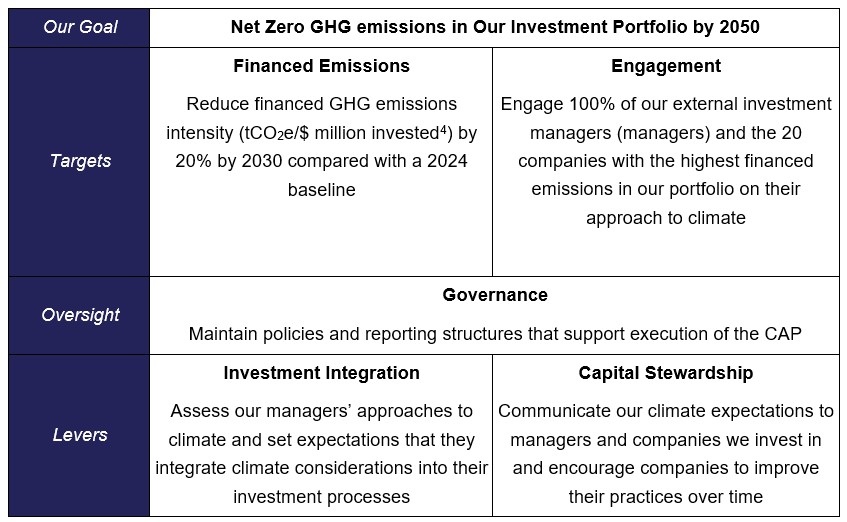
Our Climate Action Plan sets out key elements of our approach, including:
The Board and Investment Committee oversee the Climate Action Plan. Staff manage day-to-day implementation and work with external investment managers (managers) to advance climate integration, engagement, and reporting. We will review the Climate Action Plan every five years, alongside our strategic planning cycle.
We assess and monitor our managers’ approach to integrating climate considerations into investment decision-making. This includes due diligence during manager selection, annual reviews of climate integration and engagement practices, and ongoing dialogue to better understand climate risks and opportunities across the portfolio.
We engage with managers and portfolio companies to improve practices that reduce climate risk. Our plan commits to engaging all investment managers each year on their approach to climate. This includes discussions on how managers integrate climate into investment processes, what climate targets they have set, how they identify and manage climate-related risks and opportunities, and how they engage companies on climate-related issues.
We also commit to engaging the 20 companies with the highest financed emissions in our portfolio on an annual basis. These discussions may focus on transition planning, emissions reduction, and climate-related disclosure and may occur directly, through investment managers, or through a third-party engagement service provider. This work is also supported through proxy voting at companies’ shareholders meeting.
We track financed emissions in line with guidance from the Partnership for Carbon Accounting for Financials (PCAF) Global GHG Accounting and Reporting Standard, a recognized standard for calculating financed emissions.
As part of our climate action plan, we commit to a 20% reduction in tCO2e per $ million invested by 2030 relative to a 2024 base year in our listed equity and corporate bond portfolios. This target is informed by industry guidance, including the Net-Zero Asset Owner Alliance (NZAOA) Target Setting Protocol.
We recognize that achieving our target will ultimately require the companies we invest in to reduce their GHG emissions. This will depend on a range of factors, such as the availability of new technologies, the overall carbon-intensity of the grid and government policy. If governments and companies do not meet or drop their stated climate targets than it will impact our ability to achieve our financed emissions reduction goals. We also recognize that divestment from high-emitting companies will not reduce real world emissions. We therefore focus our efforts on engaging companies in our portfolio to reduce their emissions. We intend to reassess our financed emissions target every five years.
How members will be kept informed
We aim to provide transparent updates on our progress as we execute against our Climate Action Plan. We will report on our progress through the Responsible Investment Report section of our Annual Report.
Looking ahead
The Climate Action plan is an important step in our ongoing journey. We expect our approach to keep evolving as data improves, guidance develops, and market practice changes. We will remain focused on effectively managing long-term climate risks in support of members’ retirement security. If you have any questions about our Climate Action Plan, please reach out to pensionboard@united-church.ca.
[3] Net-zero refers to a state where the emissions of the companies we invest in are reduced to near-zero with any remaining emissions removed from the air.
[4] This refers to tonnes of carbon dioxide equivalents per million invested.